Miyuki have recently announced that a number of Delica colours will be discontinued by the end of this year. The full list is available on their website.
Unfortunately, two of the main colours for the Saturn Box are on this list, with no suggested alternative: DB 1456 Silver Lined Light Taupe (the light grey used as colour C in the tutorial) and DB 1458 Silver Lined Light Honey Opal (the main pale yellow “Saturn” shade used as colour B in the tutorial).
After spending a lot of time going through a huge number of possible alternatives myself I’ve managed to find an almost identical replacement for the pale grey and two possibilities for the pale yellow.
For the pale grey DB 630 Silver Lined Light Taupe Alabaster is an almost identical replacement.
For the pale yellow there doesn’t appear to be any similar silver-lined colour available. There is a slightly darker yellow available, DB 2186 Silver Lined Duracoat Vinho Verde, but in my opinion it’s a bit too bright. A better colour match is DB 2364 Duracoat Opaque Dyed Moth Wing, and although it’s a not silver-lined I think it’s a good alternative.
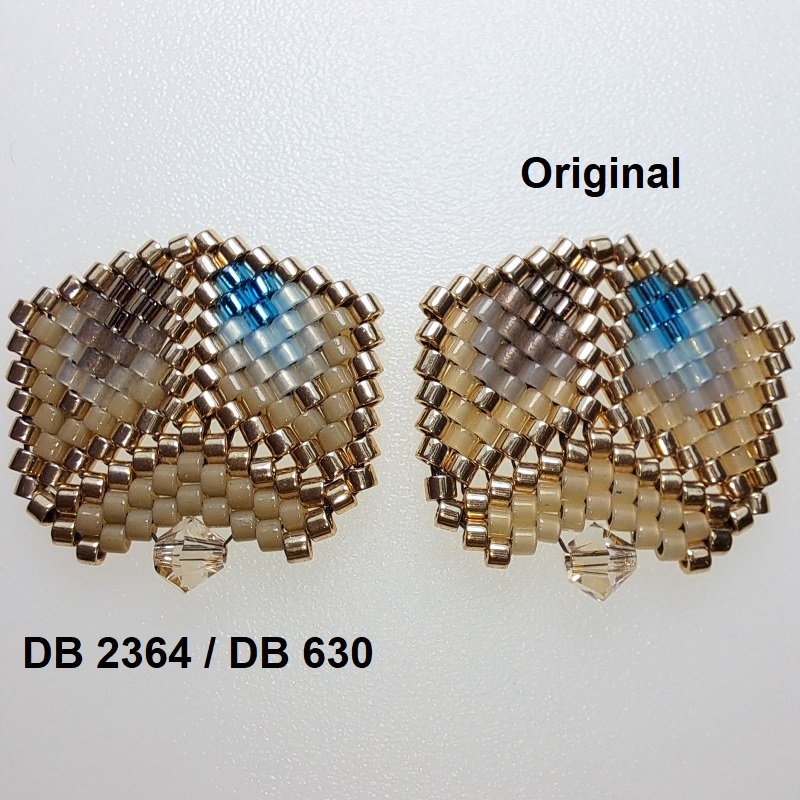
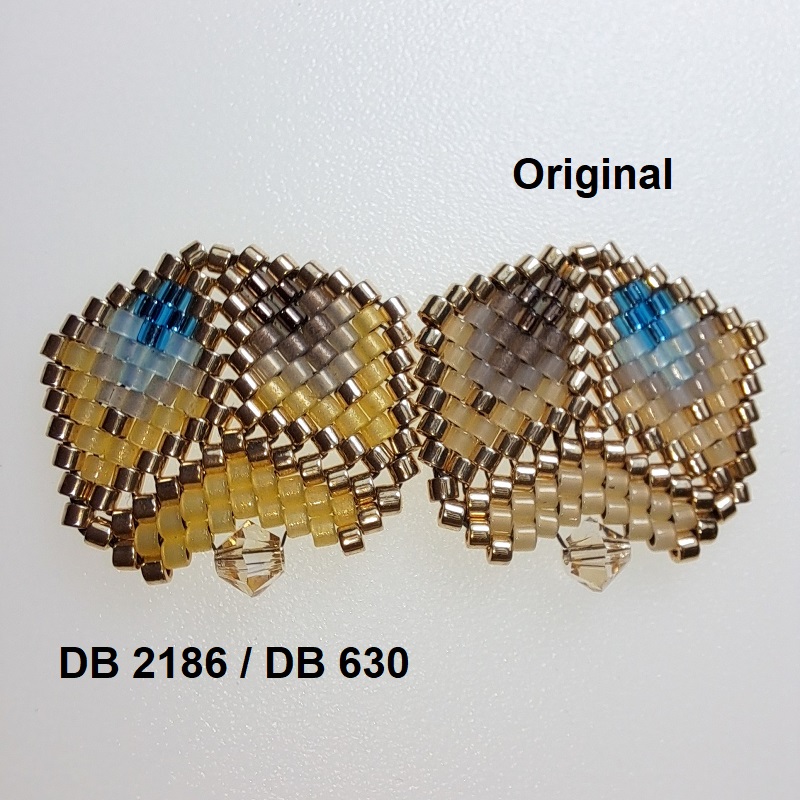
Here’s a comparison of the two options with the original colour scheme:
Here’s a comparison of just DB 2364 and DB 630 to the original:
And here’s a comparison of just DB 2186 and DB 630 to the original:
Hopefully Miyuki will add true replacement colours to their range in the near future, but for now there are some reasonable options at least! I’ve updated the tutorial on etsy to include these suggested alternatives.
The Saturn Box is a beaded geometric box I designed in 2020 for the Beadworkers Guild Journal. The tutorial originally appeared in issues 87 to 90 of the journal between 2020 and 2021.
At the time the Saturn Box was the most complicated piece I’d ever designed (or written instructions for!). It was during lockdown and I was really focussing on beadwork as a distraction. I’d never made a beaded box before, so wanted to try something new for the journal.
It combined a few different ideas I had been playing around with and thinking of how to incorporate into a bigger design – the ring of half-stars and the half-diamond finish to the edges of the bowl in particular. It’s also one of the few of my pieces that includes crystals as well. I tend to keep geometric pieces to purely peyote stitch and Delicas, but the inside of the bowl was just missing something, and that something was crystal bicones!
Of course, as soon as I included them Swarovski announced they were going to stop selling crystals to beaders – typical! Fortunately I found Preciosa made a bicone in a similar (and possibly slightly better!) colour to accent the Delicas.
The original idea for the box started off with a near-miss Johnson solid. These are polyhedra that don’t quite have regular polygon faces, so aren’t one of the 92 Johnson solids, but are so close to being so you can make them pretty well with regular polygons. Some of the known near-miss Johnson solids have unusual patterns of polygons on their surfaces which offer lots of design possibilities! The particular shape I decided to base the box on is a near-miss discovered by Robert Webb:
This polyhedron has hexagons at the top and bottom, and a ring of triangles in the middle of upper and lower rings of pentagons. This shaped seemed ideal to base a box on, as it has a clear top and bottom and could be split along the central ring of triangles to make the lid and base.
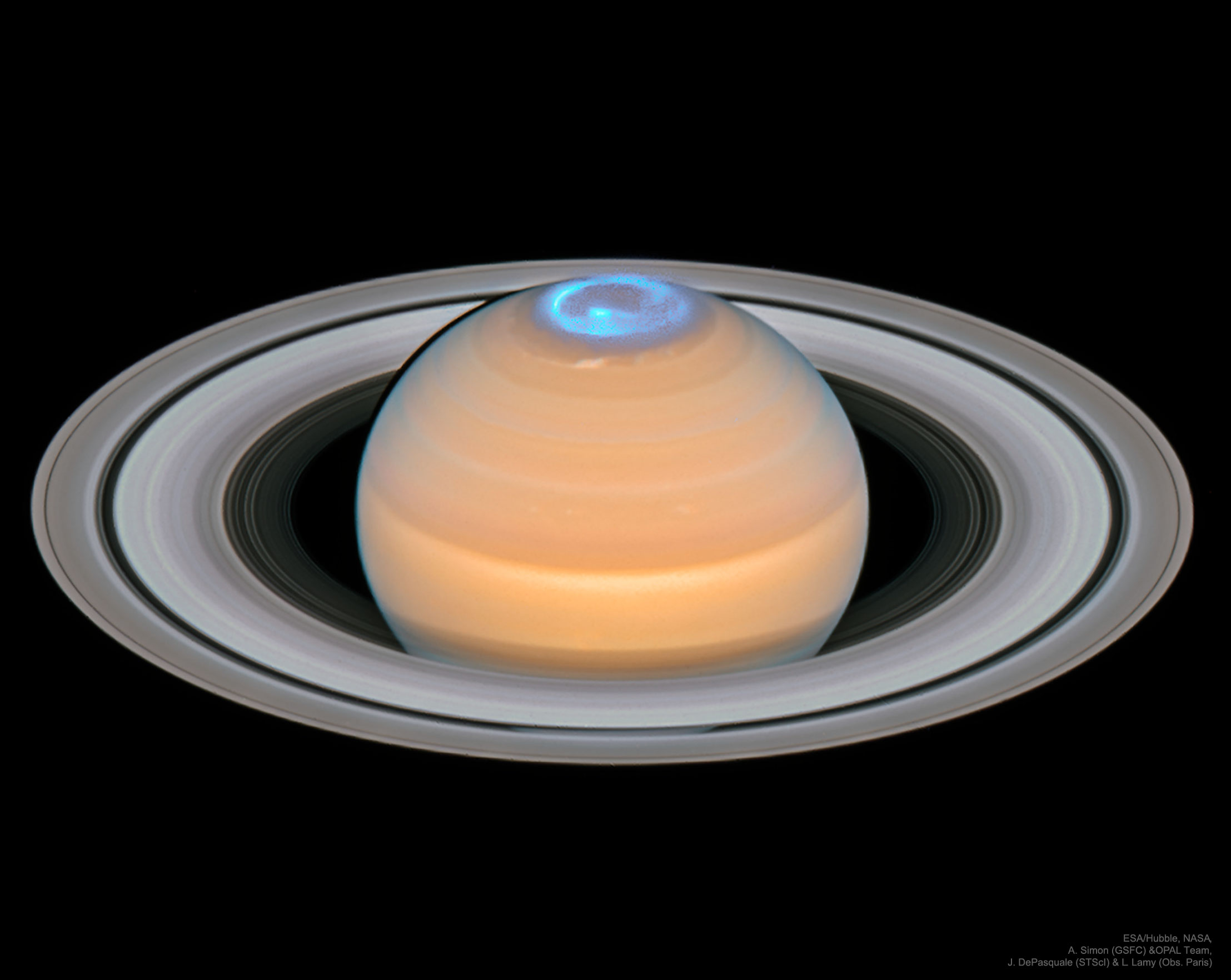
The ring of triangles would also allow me to incorporate the half-star idea I’d been playing around with into the design to form a ring around the box. I used to be an astrophysicist, and studied planets in particular, so that led me immediately to thinking about Saturn! That in turn led me to my colour inspiration – the false colour images of the aurora on Saturn:
These images were taken with the Hubble Space Telescope in 2017, and show the aurora at the North Pole of Saturn. These aurora mostly emit ultraviolet light, rather than visible light like the aurora on Earth. The image above is actually a composite image – a visible light photograph of Saturn from Hubble combined with a false colour representation of observations of the ultraviolet light captured using one of Hubble’s spectrographs. The false colour representation shows the ultraviolet light emitted by the aurora in blue, and I just love this representation of the physics and had to include it in the box design, with silver-lined beads doing their best to bring to mind this image!
After a lot of engineering and even inventing a new component I ended up with the final design! The lid of the box sits on the ring of half-stars, standing on six “spikes” formed by the points of the blue stars on the lid. I was really happy with the final design!
I’ve been meaning to write a standalone tutorial for this piece for a while – the size and complexity of the project was a bit daunting though! I finally convinced myself to sit down and start it before Christmas, and I’m really glad to now have it available in my Etsy shop.
I’m also really grateful to the small army of pattern testers who stuck with me while I tried to get this all written down in a reasonable size document the last few months!
If you decide to try making the box I hope you will enjoy it – although it is a lot of work, it’s also a varied piece with lots of different types of peyote shapes combined together. There are triangles, squares, pentagons, hexagons and some others you may not be familiar and some new ones invented just for this piece!
Although it was challenge to design and document this piece it’s a challenge I’d gladly undertake again – in fact I’m thinking of doing a few more planetary-inspired boxes!
I had a bit of free time this week so have put together some diagrams for some different colourways for the interlinked tetrahedra shape!
There are step-by-step diagrams for the silver-yellow-green, yellow-orange-red, silver-blue-purple and green-yellow-silver-blue-purple colourways. The pdf is available here: Interlinked Tetrahedra Additional Colourway Diagrams.
They match the steps in the original 3- or 5-colour instructions, which you can find here.
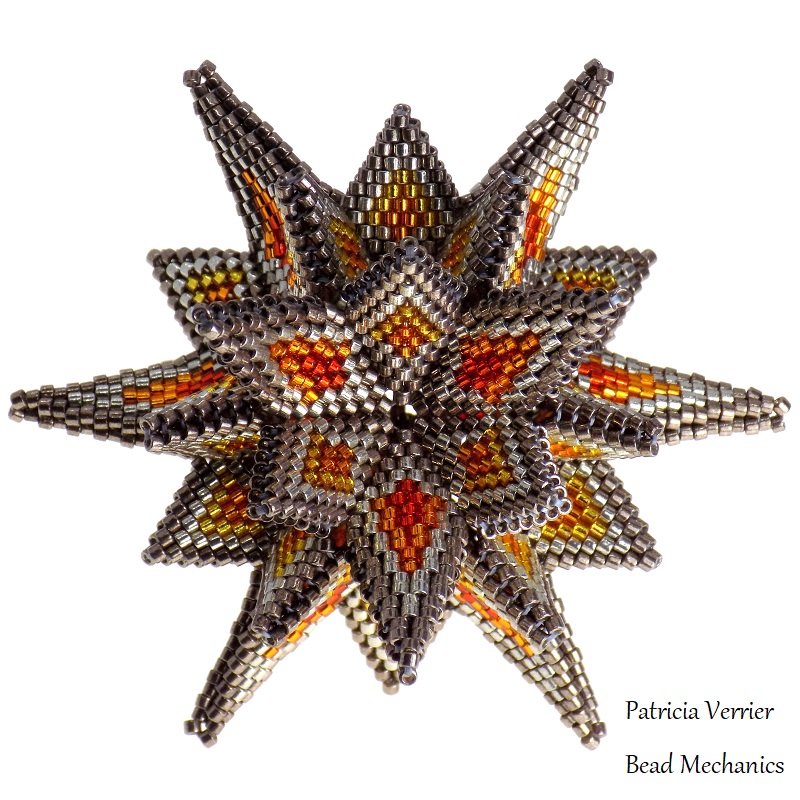
A new tutorial is available in my Etsy shop for Mira Star! This is a truncated octahedron made from warped hexagons in a similar way to Hypernova, but with a twist – it uses a mix of 1-drop and 2-drop peyote to create the different length sides and add extra dimension to the piece!
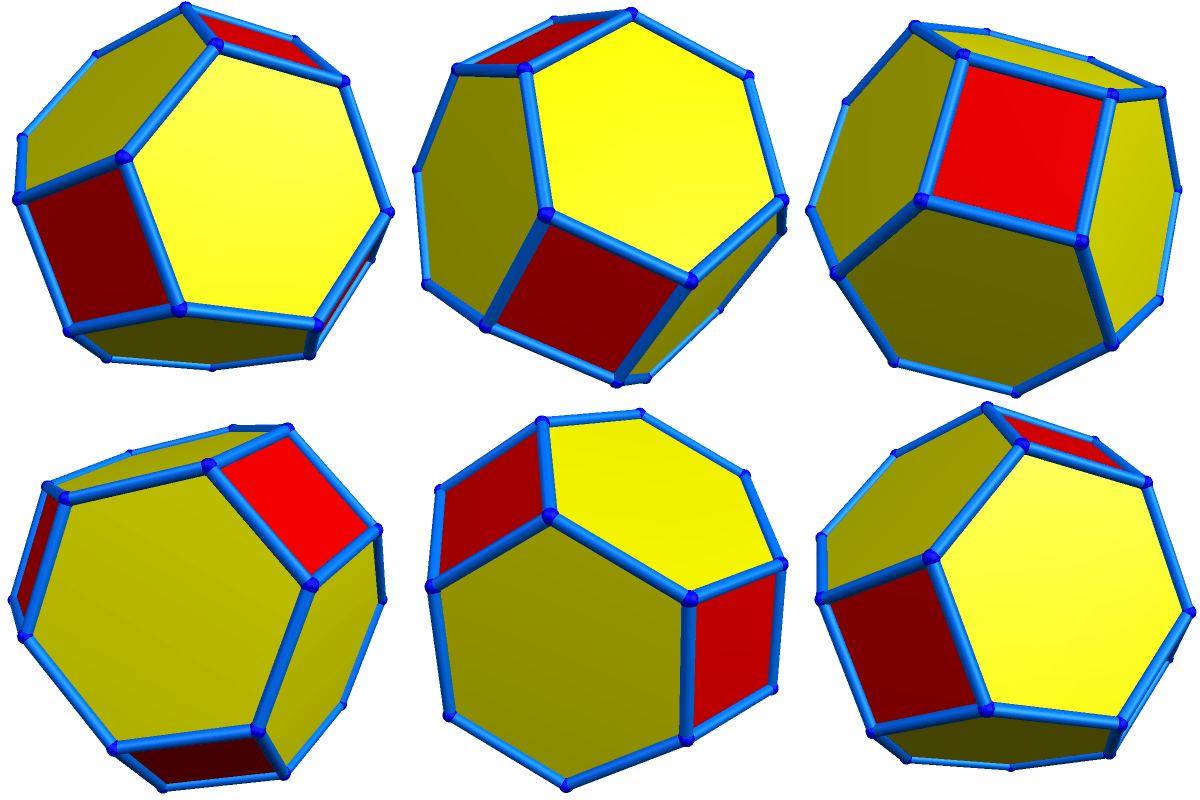
A truncated octahedron is an Archimedean solid, and it has square and hexagon faces:
I think the combination of the two different types of faces with the different types of peyote works really well! The shape looks very different from different angles:
I named it Mira Star as the different lenghs of the sides made me think of variable stars, stars which periodically increase and decrease in brightness. A Mira variable is a particular type of these variable stars.
I love the orange silver lined beads I used in this piece, but I also made a version in green as well:
I really like this version too, not sure which is my favourite!
I decided to add a cord to this one so it can be hung as an ornament – it looks really good like this as you can rotate to see all the different sides.
Both colourways and a guide on how to make the cord to hang it as an ornament are in the tutorial.
Happy beading!
The animation of the truncated octahedron shown in this post was created with Stella4D Pro.
Reconfigurable materials are materials without a fixed shape – surfaces with a shape that can be changed to different configurations. They have some similarities to kaleidocycles and folding cubes, as you can see from this video from the Harvard John A Paulson School of Engineering and Applied Sciences:
Here’s another video from Johannes Overvelde, one of the researchers who studies these surfaces:
Diane Fitzgerald recently posted a challenge in the Johnson Solids Project group on facebook to try making beadwork versions of these structures. Lots of people rose to the challenge and before long there were lots of photos of beaded reconfigurable materials!
You can see that it follows the outline of a hexagonal prism, with pairs of squares added to each edge. It reconfigures to a lot of different shapes:
It’s interesting to see just how different it can be made to look! However, it is also however very fragile, as the peyote squares put the corner beads under a lot of pressure, so you need to be very very careful with it (I had a sliver of glass ping off one of the beads while folding it into a different shape!).
If you want to try making one of these fragile but interesting shapes, here’s a brief walkthrough of how I made this hexagonal prism unit. I used the same sized squares as in the Beaded Johnson solid project and used size 15 seed beads for the hinges.
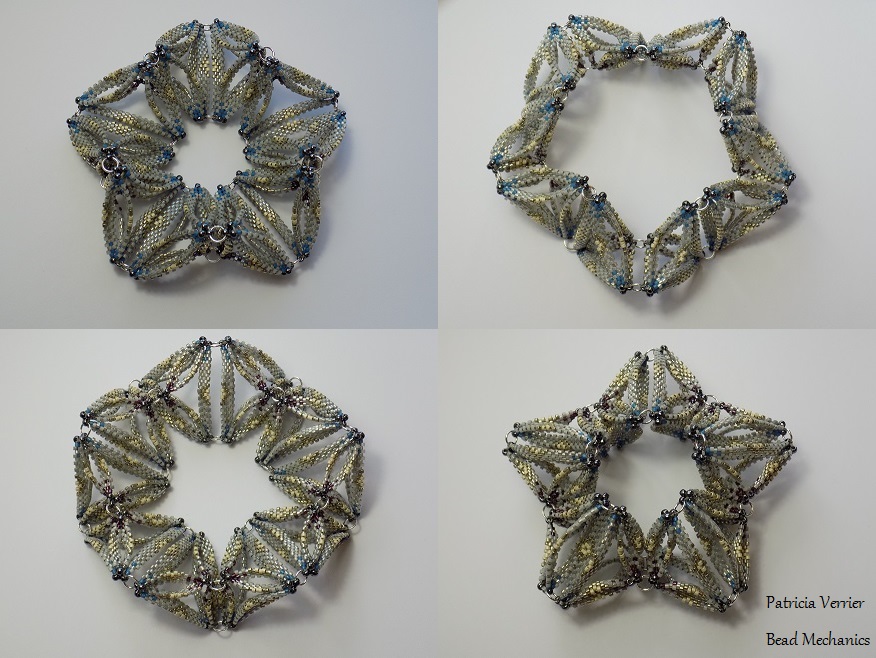
Some while ago I made a decagonal kaleidocycle using irregular tetrahedra based on a paper model of a half-closed decagonal kaleidocycle by Gijs Korthals Altes. Because the tetrahedra have different length sides the different faces you see as it turns are all different shapes.
I drafted a tutorial for this a while ago, and have finally got around to finishing it – and here it is!
This kaleidocycle is made from ten tetrahedrons. Each tetrahedron is made from six peyote ovals. There are two different types of tetrahedra and each of these contains four different types of ovals.
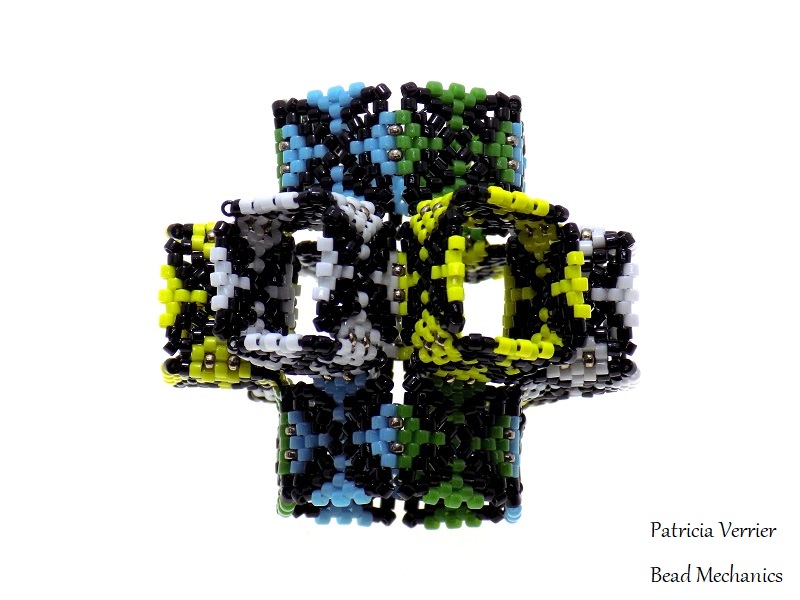
The original five colour version of the bugle bead interlinked tetrahedra is available here as a pdf: Five Colour Interlinked Tetrahedra Tutorial. This version uses a different colour for each individual tetrahedron.
Three Colour Interlinked Tetrahedra
A three colour version of the interlinked tetrahedra tutorial is available here: Three Colour Interlinked Tetrahedra Tutorial. This version uses three different colours of bugles in each tetrahedron.
The animations above were made using Stella4D Pro.
Additional Colourways
Diagrams for other colourways are available here: Interlinked Tetrahedra Additional Colourway Diagrams. These are diagrams for each step for the silver-yellow-green, yellow-orange-red, silver-blue-purple and green-yellow-silver-blue-purple colourways.
Kits
Kits for both versions are available in my etsy shop!
It’s the start of International Beading Week! The week is a world wide celebration of the craft, aiming to bring beaders together and encourage people to try some beading!
There are a lots of events being held this week – you can read about them here. There’s also a wealth of free patterns that have been donated by designers all over the world in celebration – and you can browse through them all here.
This year I’m acting as a Guest Ambassador, and as part of that I’ve written a free tutorial for the bugle bead interlinked tetrahedra design!
You may remember this shape from a previous blog post about it. It’s based on the origami model Five Intersecting Tetrahedra by Thomas Hull. With his permission, and with the help of the brilliant geometric software Stella4D for the diagrams, I put together a step by step guide on how to assemble the beaded version. The pdf of the tutorial is available from the IBW downloads page and is also linked below!
The piece is a fun geometric challenge, and requires very little previous beading experience so is suitable for anyone thinking of trying some beadwork for the first time as well!
A new tutorial is available in my Etsy shop for the Rhombic Mosaic icosahedron! This icosahedron is Not Made From Triangles! Instead it uses peyote diamonds for a new take on this basic geometric shape!
This method of making an icosahedron means than you get distinct triangular faces rather than the diamond shaped faces you get if you use triangles. Here’s a comparison of two – Rhombic Mosiac is on the left and an icosahedron made from peyote triangles on the right:
I really like the effect this construction method gives! I started working on this idea last year with my initial Not Made From Triangles tetrahedron:
Since then I’ve tried a few other shapes as well – here is a Not Made From Triangles octahedron along with the triangle version:
I really enjoy making polyhedra using this method and have a number of other shapes already planned!
The pattern in the tutorial uses five different colours for the faces of the icosahedron and has every possible combination of each five at each vertex exactly once. Both colourways are in the tutorial too!
This video of a kaleidocycle made from peyote ovals was the first post on my blog almost four years ago.
The tape on my hands in the video is to cover up scrapes from rowing, not beading the kaleidocycle – and since I can’t go out to row at the moment I took the opportunity instead to finish the tutorial for it that I drafted several years ago to share with you all!
This kaleidocycle is made from six tetrahedrons. Each tetrahedron is made from six peyote ovals. The ovals are all identical apart from the two accent colours used in the pattern. There are then two different combinations of the ovals to form the tetrahedra – pattern 1 and pattern 2, which is a mirror image of pattern 1.











 Bead Mechanics