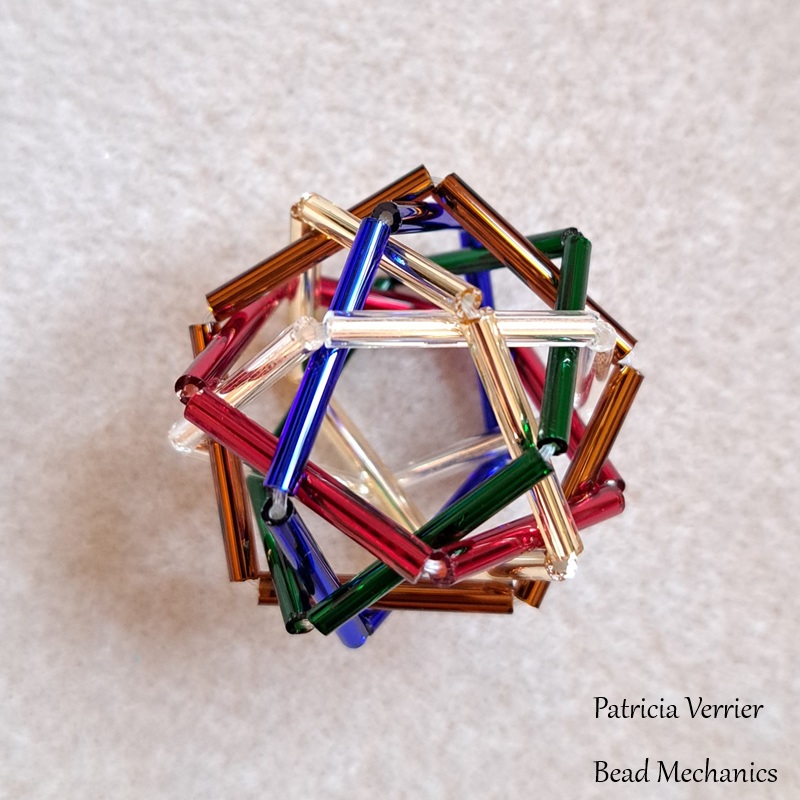
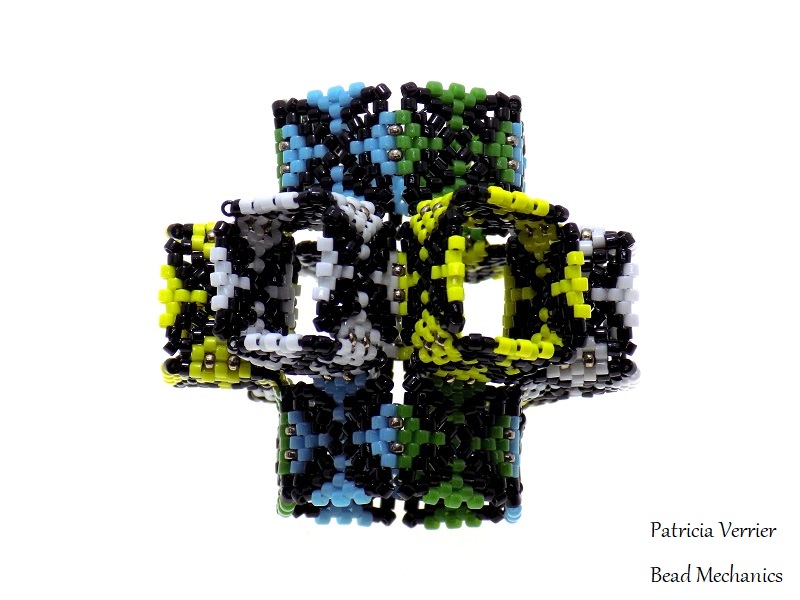
After a bit of trial and error with various sizes of bugle beads I’ve managed to succeed in making a bugle bead version of the well-known pentagon tangle! This shape is made from six intersecting pentagons, woven together to form a rigid structure.
It’s one of a type of shape known as a Regular Polylink or Orderly Tangle, and there’s quite a bit of research into them. This particular one turned out to work with 20mm bugles, and my first attempt above used straight bugles and worked really well. My second attempt below used twisted bugles, which are a bit thinner so it’s not as stable as the first attempt.
It’s turns out to be quite difficult to find six different colours of bugles, let alone ones that go well, and as a result the first two I made are in a selection of slightly random colours For the third attempt I managed to find a variety of black, grey, white and clear beads, which is so far my favourite version.
This shape turned out to be far more challenging than the interlinked tetrahedra, and although I’ve made three of them now I still don’t have a good method to follow. However, I’ve managed to get more suitably sized bugles, so the research and development continues!
It’s been a while since I last wrote about the UK Johnson Solids Project – a UK iteration of Diane Fitzgerald’s amazing community project in the US. Sylvia Fairhurst, who organised the UK incarnation, has been busy looking for places to exhibit the collection since its completion. This was challenging when the project initially concluded, as we were in the middle of the pandemic, so open venues were few and far between. However, as the world has opened back up and beading meet ups have resumed the project is now finding places to be displayed.
The current venue is Spellbound Beads in Lichfield, just north of Birmingham. If you’ve not had the chance to visit them in person then maybe this is the excuse you need! (I recently managed to visit them myself for the first time after having spent many years ordering many beads from them online – it’s a fantastic bead shop and I highly recommend a visit!)
Photograph courtesy of Spellbound Beads.
You can view all 92 beaded Johnson Solids – along with the Archimedean and Platonic solids that were also part of the UK project – at Spellbound over the next 6 weeks. To find out more check out their Facebook page or website.
And if you’d like to read more about the original Johnson Solids Project, Diane has published a booklet about it complete with instructions on how to get starting with making these shapes. Find it in her esty shop!
Miyuki have recently announced that a number of Delica colours will be discontinued by the end of this year. The full list is available on their website.
Unfortunately, two of the main colours for the Saturn Box are on this list, with no suggested alternative: DB 1456 Silver Lined Light Taupe (the light grey used as colour C in the tutorial) and DB 1458 Silver Lined Light Honey Opal (the main pale yellow “Saturn” shade used as colour B in the tutorial).
After spending a lot of time going through a huge number of possible alternatives myself I’ve managed to find an almost identical replacement for the pale grey and two possibilities for the pale yellow.
For the pale grey DB 630 Silver Lined Light Taupe Alabaster is an almost identical replacement.
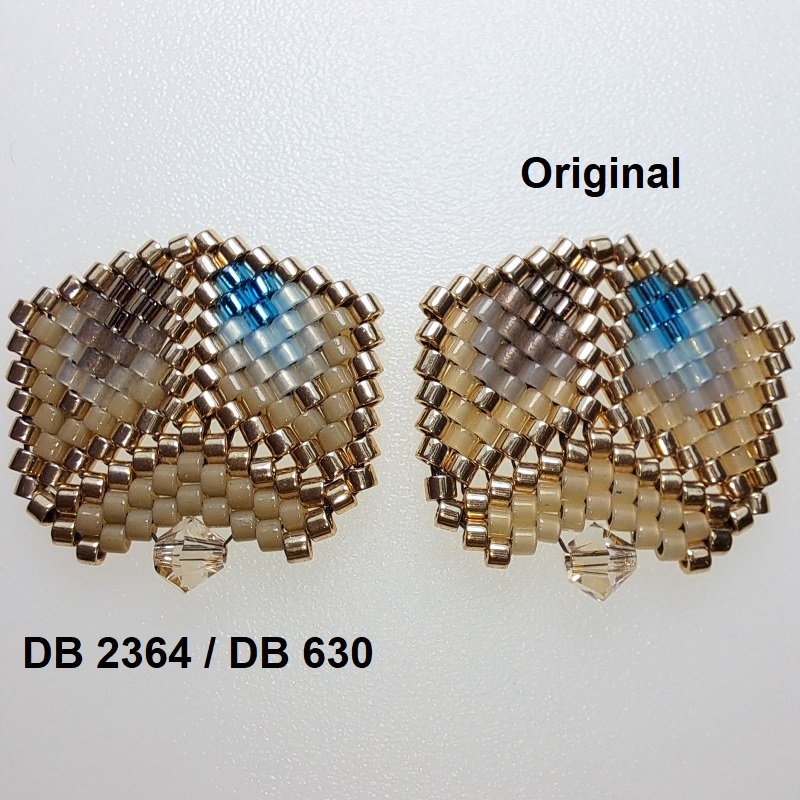
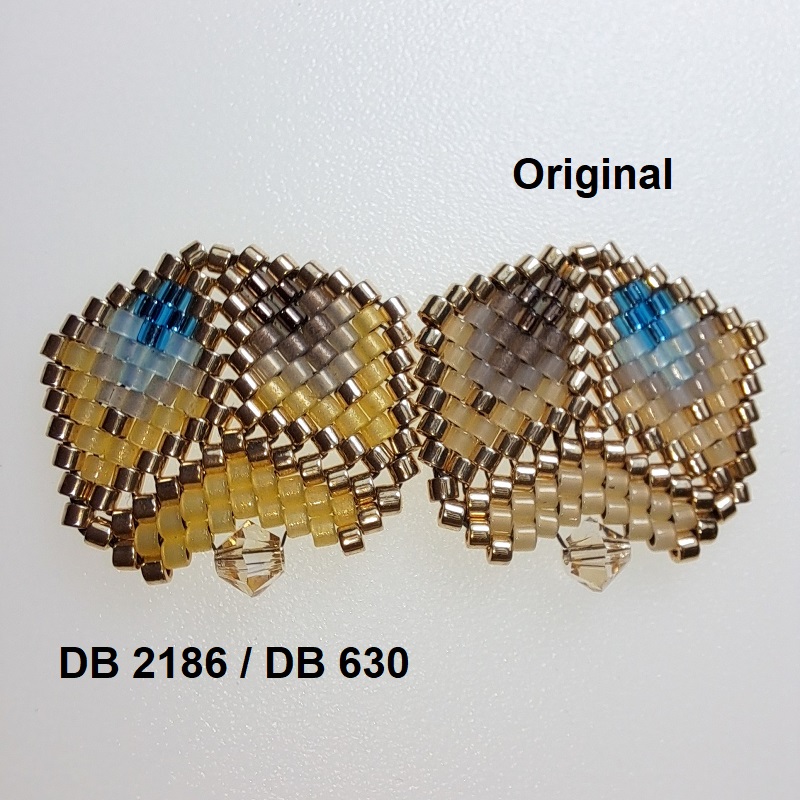
For the pale yellow there doesn’t appear to be any similar silver-lined colour available. There is a slightly darker yellow available, DB 2186 Silver Lined Duracoat Vinho Verde, but in my opinion it’s a bit too bright. A better colour match is DB 2364 Duracoat Opaque Dyed Moth Wing, and although it’s a not silver-lined I think it’s a good alternative.
Here’s a comparison of the two options with the original colour scheme:
Here’s a comparison of just DB 2364 and DB 630 to the original:
And here’s a comparison of just DB 2186 and DB 630 to the original:
Hopefully Miyuki will add true replacement colours to their range in the near future, but for now there are some reasonable options at least! I’ve updated the tutorial on etsy to include these suggested alternatives.
A new tutorial is available in my Etsy shop for Mira Star! This is a truncated octahedron made from warped hexagons in a similar way to Hypernova, but with a twist – it uses a mix of 1-drop and 2-drop peyote to create the different length sides and add extra dimension to the piece!
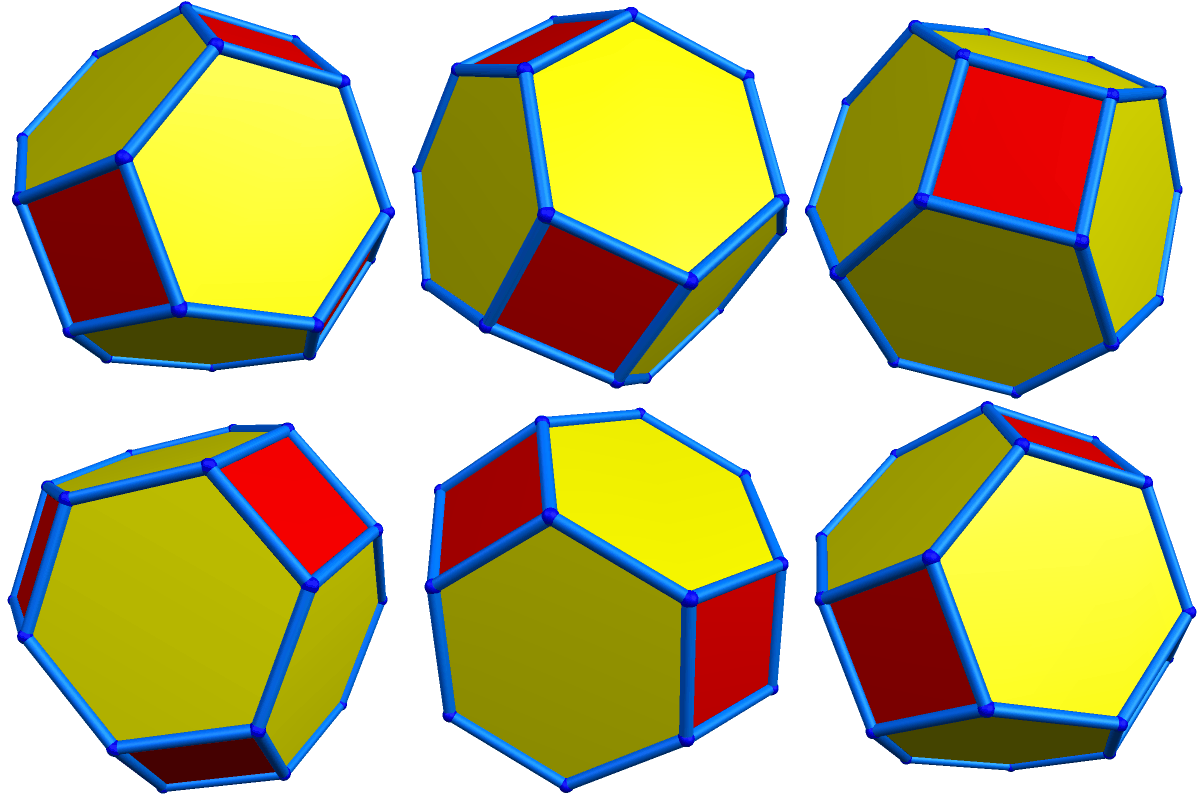
A truncated octahedron is an Archimedean solid, and it has square and hexagon faces:
I think the combination of the two different types of faces with the different types of peyote works really well! The shape looks very different from different angles:
I named it Mira Star as the different lenghs of the sides made me think of variable stars, stars which periodically increase and decrease in brightness. A Mira variable is a particular type of these variable stars.
I love the orange silver lined beads I used in this piece, but I also made a version in green as well:
I really like this version too, not sure which is my favourite!
I decided to add a cord to this one so it can be hung as an ornament – it looks really good like this as you can rotate to see all the different sides.
Both colourways and a guide on how to make the cord to hang it as an ornament are in the tutorial.
Happy beading!
The animation of the truncated octahedron shown in this post was created with Stella4D Pro.
About two years ago I posted about Archimedean Edge Hyparhedra – Archimedean polyhedra made by placing warped squares over the edges of the polyhedra. At that point I’d completed 3 of the 13 polyhedra, and started 3 more. I thought it was about time for an update on my progress on this series – I now have 7 of them completed!
Here’s a close up of the snub dodecahedron. This one is a really interesting shape, and it’s also a chiral polyhedron – it looks different reflected in a mirror – so I might make a mirror image to match when I eventually finish this series! Because of the angle of the edges of this polyhedron the warped squares end up curving the wrong way to form surface, so it ends up inside out and looking like its dual shape like the cuboctahedron.
The rhombicosidodecahedron however workd really well with the warped squares! It took me a while to finish this one as it was a lot of squares (120!) but I’m really pleased with how it turned out.
The truncated icosidodecahedron turned out really well too. It didn’t take quite as long as it’s only 60 squares, but was still a bit of a marathon. I really like this shape though, it was one of the very first ones I started and I’m really glad to have finished it at last.
The last shape, the truncated cube, was more challenging. The problem with this one is that it has octogonal faces, which need 8 warped squares to join together. Unfortunately, 8 warped squares joined together are not flat or concave, but instead start to ruffle and concertina and don’t make a very good interpretation of a flat shape – here’s my initial attempt::
It just wasn’t going to work, but I realised that if I used 2-drop peyote on the parts of the warped square that join into the octagons then they would be more pointy and the shape would be more concave rather than starting to ruffle like above. Fortunately this worked, and made an interesting shape!
The 2-drop octagons really give it a different character to the other shapes:
I was wondering how I would do the 4 Archimedean solids which have octagon and decagon faces, as I didn’t think they would work with the normal warped squares, so I’m glad I’ve found a solution and can now make the other 3 – a truncated cuboctahedron, a truncated dodecahedron and a truncated icosidodecahedron.
That leaves me with the snub dodecahedron and rhombicuboctahedron to do with the normal 1-drop warped squares, both of which are in progress. I think the snub dodecahedron will end up like the snub cube and cuboctahedron, looking more like its dual. I’m not sure about the rhombicuboctahedron yet, it could go either way or not work at all, and might have to be done with the 2-drop method instead. Hopefully it will take me less than 2 years this time to complete the set!
I’ve been trying out some new colour combinations for the bugle bead Interlinked Tetrahedra! Here’s a new version of the original five-colour one in silver, yellow, green, blue and purple:
And here’s the three-colour version in silver-blue-purple:
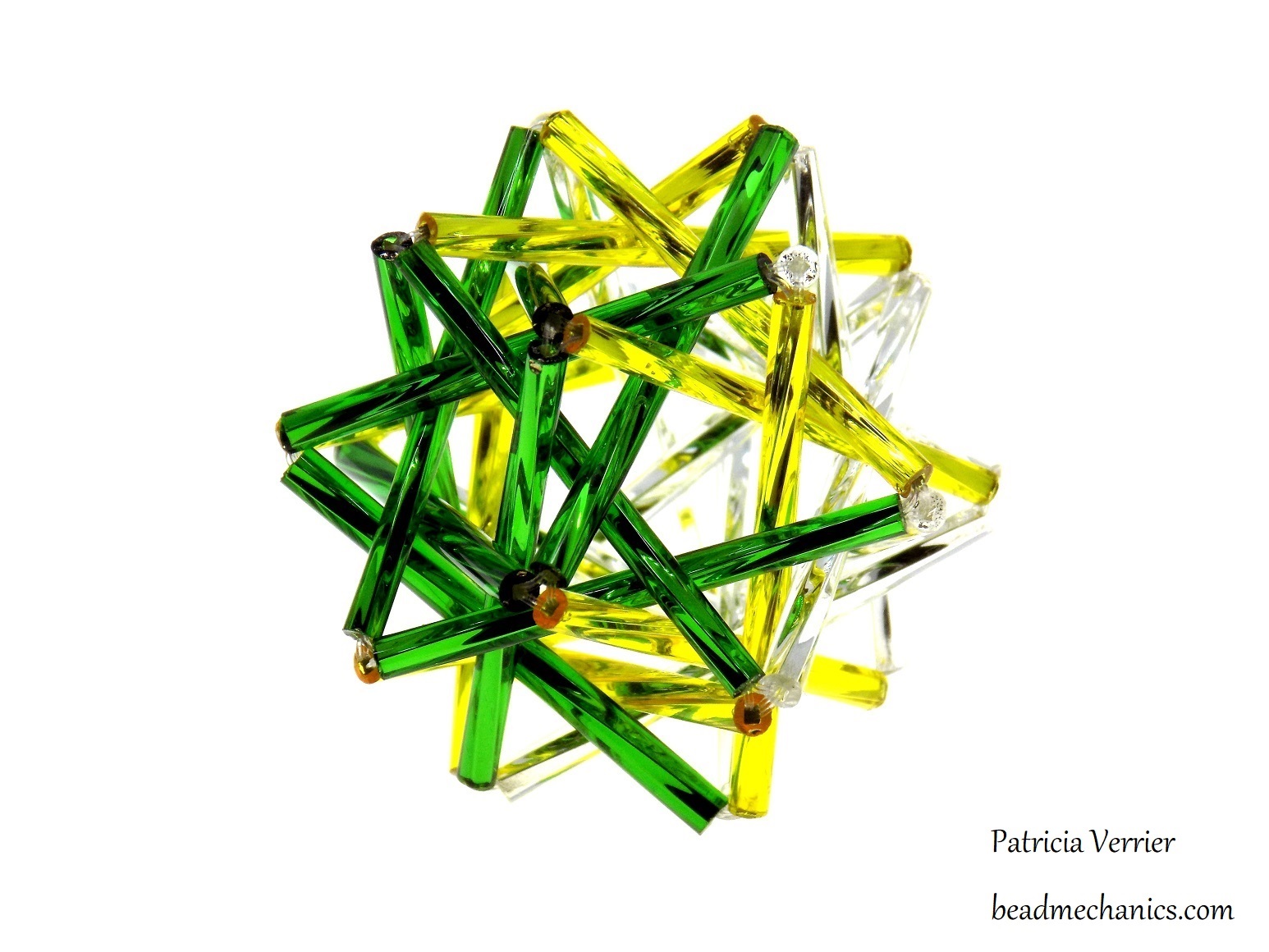
And another version in green, yellow and silver:
I’ve enjoyed playing with the different colour combinations, and I still really love making this piece, it works up quickly and is a really interesting mathematical object. I have a lot of them scattered around my house now!
You can find the tutorials for both the 5- and 3-colour versions here, and I have kits for these new colourways along with the originals in my Etsy store.
Reconfigurable materials are materials without a fixed shape – surfaces with a shape that can be changed to different configurations. They have some similarities to kaleidocycles and folding cubes, as you can see from this video from the Harvard John A Paulson School of Engineering and Applied Sciences:
Here’s another video from Johannes Overvelde, one of the researchers who studies these surfaces:
Diane Fitzgerald recently posted a challenge in the Johnson Solids Project group on facebook to try making beadwork versions of these structures. Lots of people rose to the challenge and before long there were lots of photos of beaded reconfigurable materials!
You can see that it follows the outline of a hexagonal prism, with pairs of squares added to each edge. It reconfigures to a lot of different shapes:
It’s interesting to see just how different it can be made to look! However, it is also however very fragile, as the peyote squares put the corner beads under a lot of pressure, so you need to be very very careful with it (I had a sliver of glass ping off one of the beads while folding it into a different shape!).
If you want to try making one of these fragile but interesting shapes, here’s a brief walkthrough of how I made this hexagonal prism unit. I used the same sized squares as in the Beaded Johnson solid project and used size 15 seed beads for the hinges.
This one is quite a bit smaller than the J68 I made for the US project, but still took me a while to make as it has a lot of components. There are 15 triangles, 15 squares and 7 pentagons in total, and it is made up of a pentagonal cupola (which is Johnson solid number 5) and a pentagonal rotunda (Johnson solid number 6) joined together by a decagonal prism (essentially a ring of ten squares around the middle).
The J68 I made also has a pentagonal cupola as part of the shape (this is a decagonal face made up of a pentagon surrounded by squares and triangles) so I thought it would be nice to use the same colours to highlight the connection between them and the two projects.
The shape is interesting as it looks completely different from different sides. I really like the pentagonal rotunda side (a partial icosidodecahedron made from pentagons and triangles) as well.
I really glad that I got to make a second Johnson Solid for the UK project – it’s been fun making a piece that’s very different to the other shape!
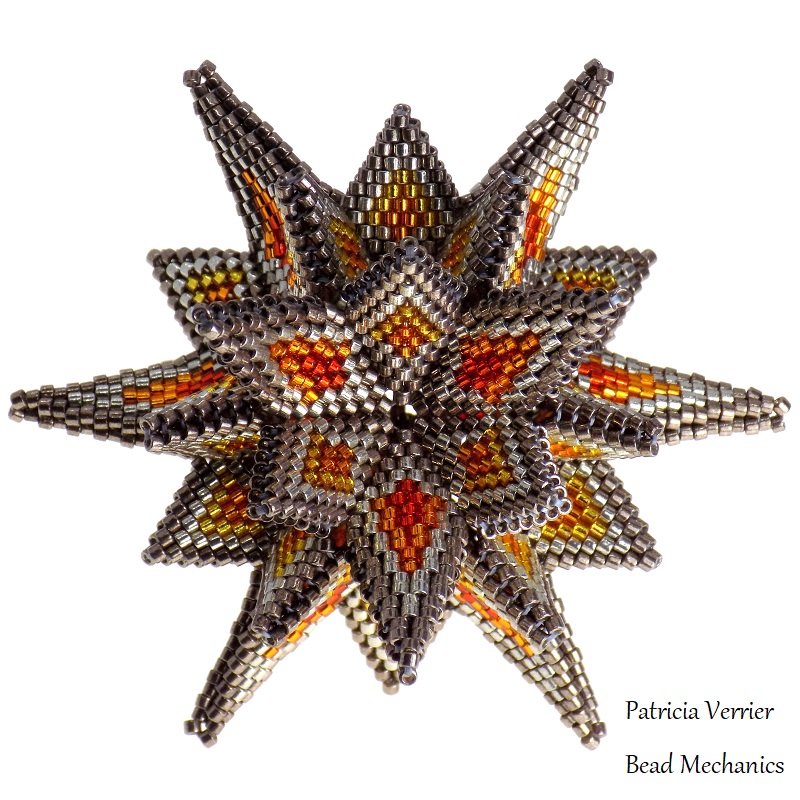
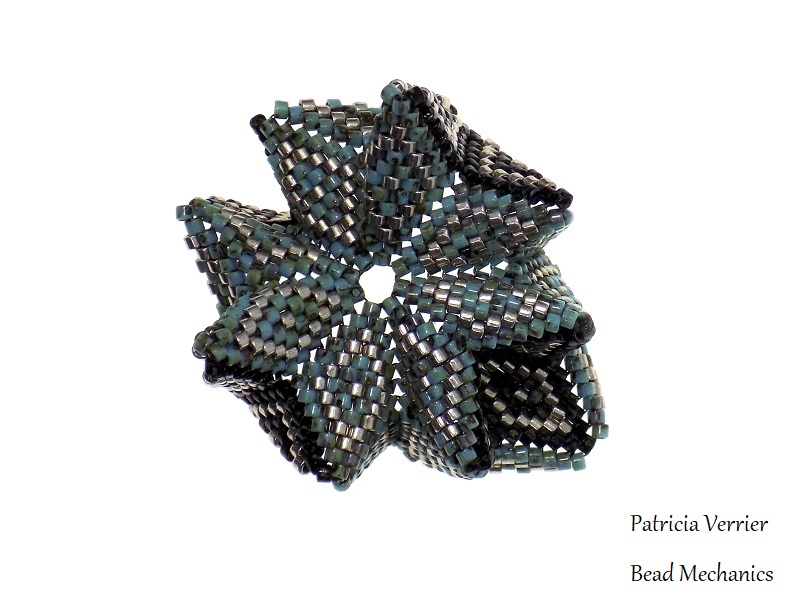
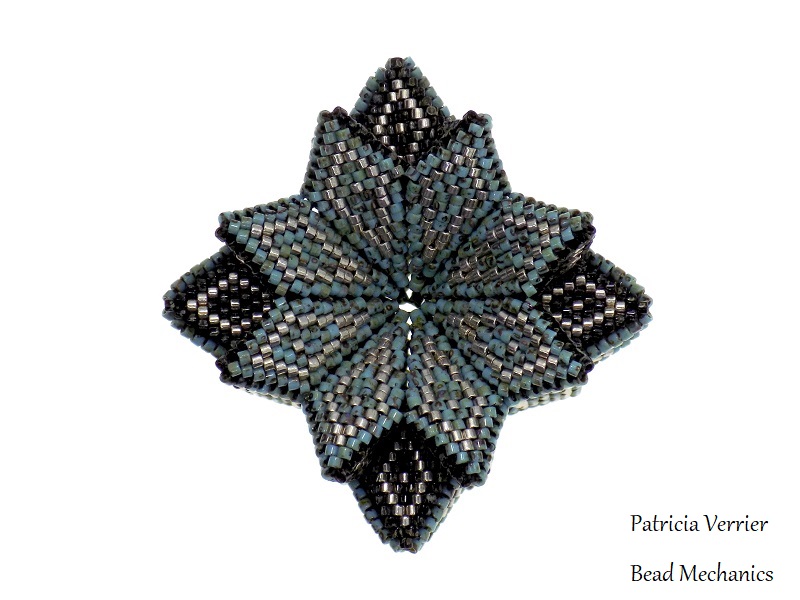
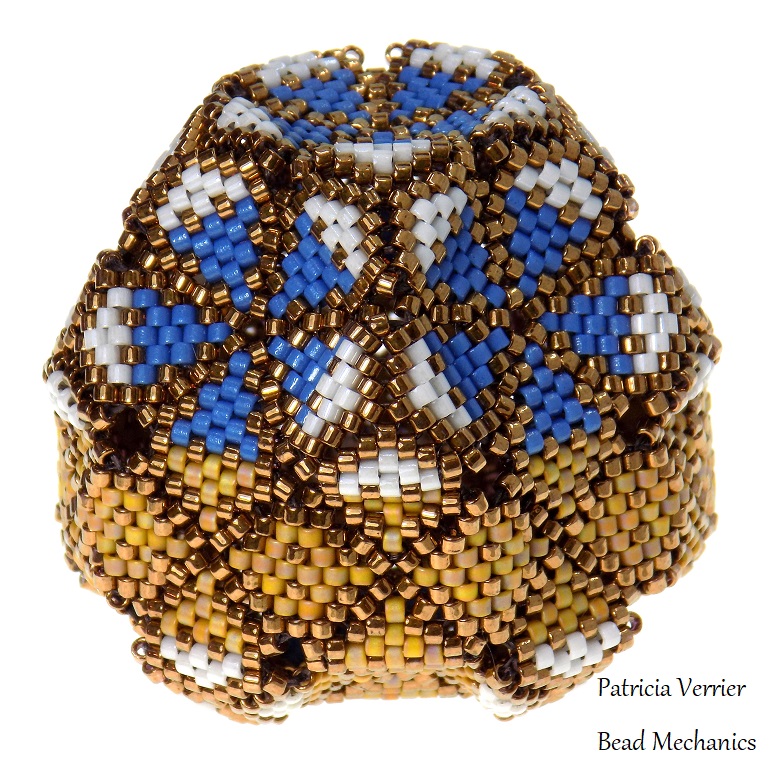
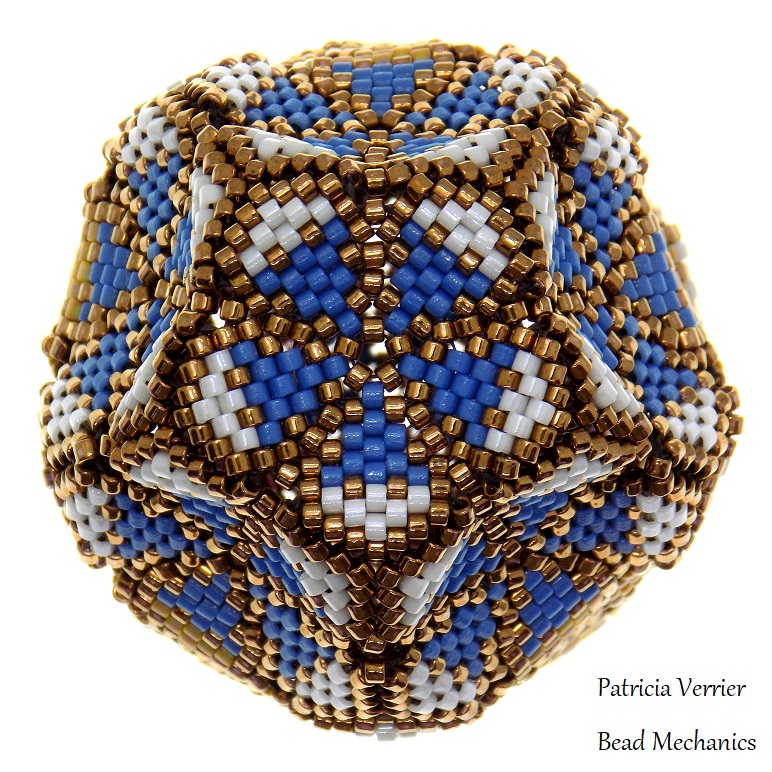
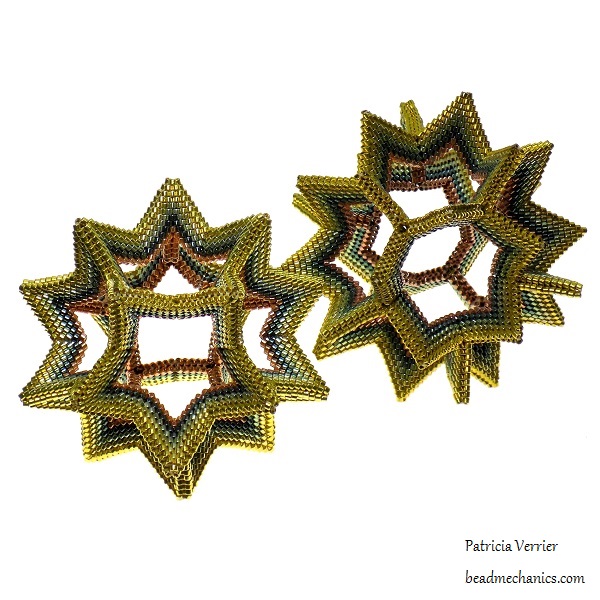
Here’s a variation on my Sunburst dodecahedron from a while back. Unfortunately it wasn’t very sunny when I tried to photograph it though!
It’s made in the same way with Sue Harle’s diagonal tubular peyote technique, but the construction is a bit different. Here it is side by side with the original version:
The difference is where the outward points are on each side – in the original they are in the middle of the edges of the polyhedron, while in the variation they are at the vertices. I really like the contrast between the two shapes!
This technique is so flexible – which means I have a lot more polyhedra like this planned!
The original five colour version of the bugle bead interlinked tetrahedra is available here as a pdf: Five Colour Interlinked Tetrahedra Tutorial. This version uses a different colour for each individual tetrahedron.
Three Colour Interlinked Tetrahedra
A three colour version of the interlinked tetrahedra tutorial is available here: Three Colour Interlinked Tetrahedra Tutorial. This version uses three different colours of bugles in each tetrahedron.
The animations above were made using Stella4D Pro.
Additional Colourways
Diagrams for other colourways are available here: Interlinked Tetrahedra Additional Colourway Diagrams. These are diagrams for each step for the silver-yellow-green, yellow-orange-red, silver-blue-purple and green-yellow-silver-blue-purple colourways.
Kits
Kits for both versions are available in my etsy shop!













 Bead Mechanics