Beaded machines, Beadwork

Kaleidocycles

I’ve been making slow progress on beadwork over the summer, but I have had a bit of time to learn more about kaleidocycles and plan out my next project! Unfortunately I haven’t quite finished the current project (more on that soon) but meanwhile I realised I only ever posted a video of my first kaleidocycle and not any photos, so here it is in more detail!

kaleidocycle1_beadmechanics

And here’s the opposite set of faces:

kaleidocycle2_beadmechanics

Finally, here’s a view from the side:

kaleidocycle3_beadmechanics

Can’t wait to start the next one!

Beadwork, Polyhedra

Icosahedron

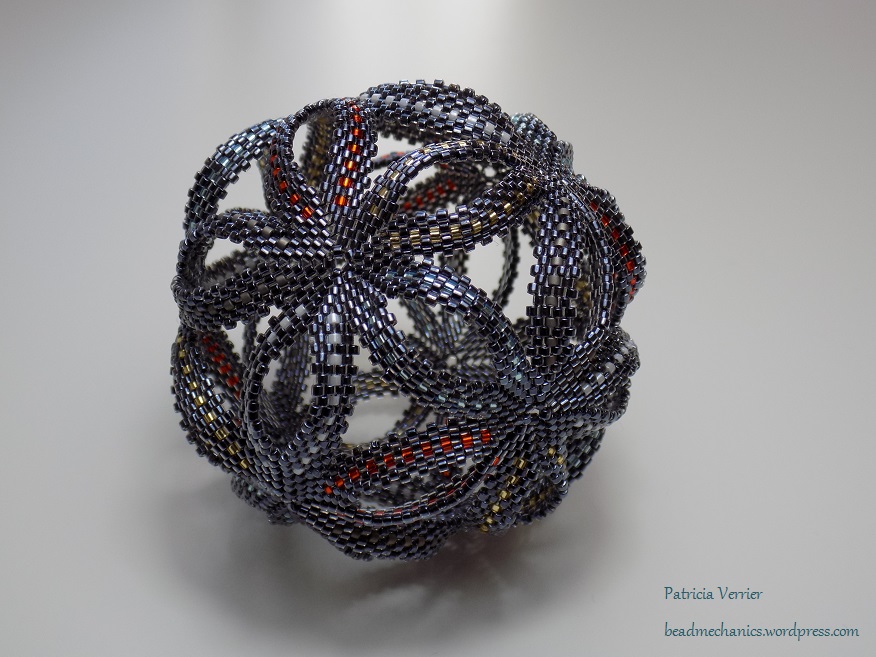
I’m busy making a new geometric sculpture, so I thought I’d take a break and take look back at an older piece. This is an icosahedron I made almost 2 years ago now.

icosahedron_verrier

I say icosahedron, but it’s really half way between an icosahedron and a dodecahedron. If you think of the beaded ovals as the edges, then you can find groups of three that make the triangular faces of an icosahedron, but you can also find groups of five that make pentagons and overall look like a dodecahedron. However, I based it on a icosahedron when I was making it, so that’s what I’ll call it!

Unlike my beaded dodecahedron, this piece has a chirality because of how the ovals are arranged to make each face. Chirality just means that a shape looks different to its mirror image. You can see that here – the ovals all point out clockwise around each triangle, but the mirror image would have them all pointing anticlockwise. One day I’ll make the mirror image version to match!

I’d also like to try this pattern as a truncated icosahedron (which is an icosahedron with the vertices cut off, so it’s made up out of pentagons and hexagons – like a football). I think it’d look good as a larger shape, but I’m slightly put off by the 90 edge pieces I’d have to make!
 

Bangles, Beadwork

Mookite Rick-Rack

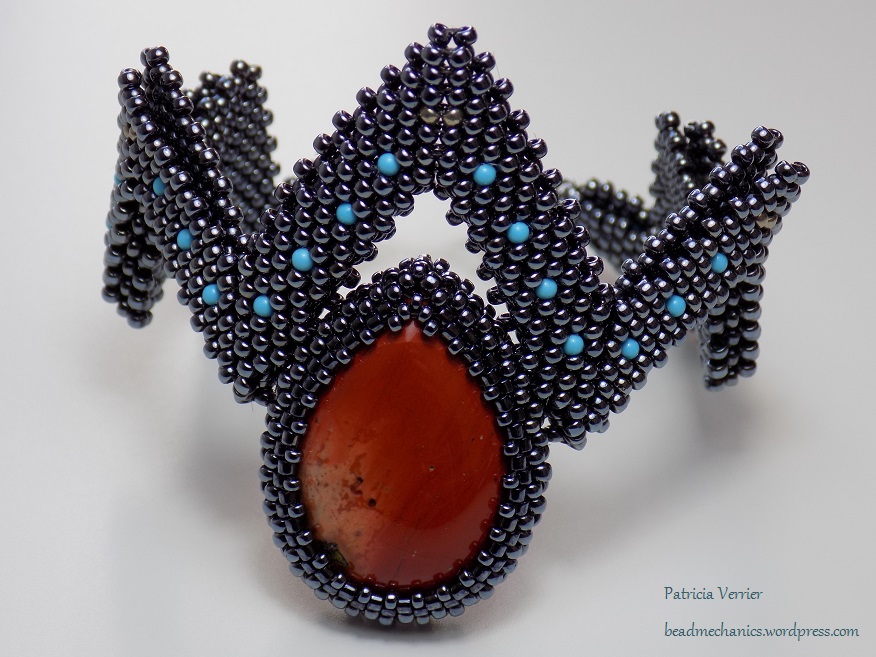
Work has been slow on my next geometric shape, so I thought I’d revisit a piece I made about this time last year: a double rick-rack with a Mookite cabochon. There are some great bangles with tear-drop stones in the Contemporary Geometric Beadwork project — see the CGB facebook page for a photo of an amazing one by Cate Jones! When I saw this cabochon I knew what I had to make with it!

It’s a bit of a departure from my normal work as it’s the only bangle I’ve made in the flat and the only one I’ve made with size 11 seed beads instead of delicas. I really like the effect of the seed beads though, and their larger size made it possible to mix in a row of 2mm stones as well.

mookite_rickrack1

It’s a standard rick-rack built off an MRAW base, with a slightly larger peak in the centre than the sides. The bezel for the Mookite cabochon is also a simple MRAW band with a few rows of delicas and size 15 seed beads on the back and front. It’s joined to the band using a few extra stiches and beads at the sides of bezel.

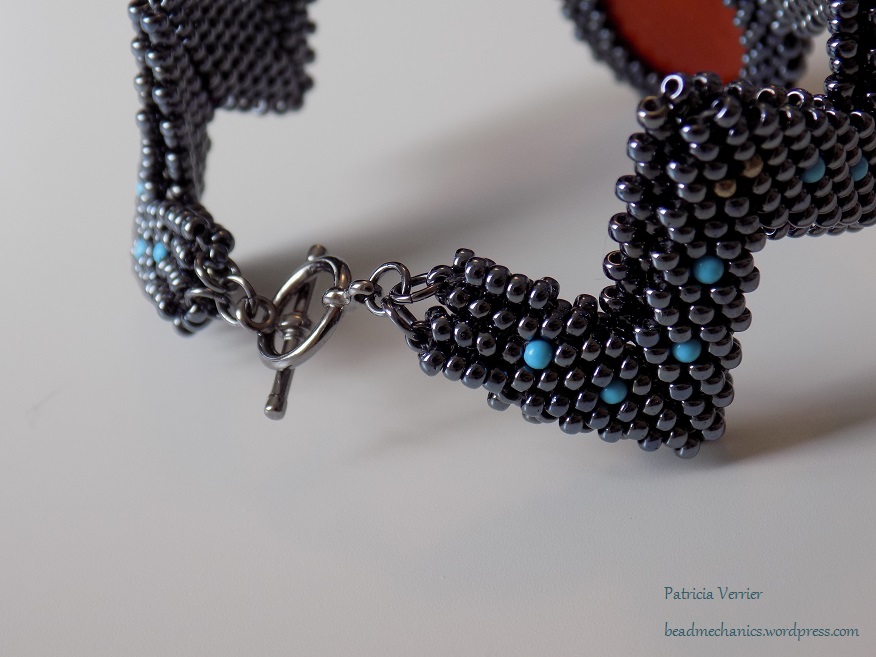
When working in the flat there’s always the question of what to do at the ends. I decided to finish them straight and use that edge as a base for a few rows of herringbone stitch on both the front and back. I then joined the band to a simple toggle clasp with a couple of jump rings.

mookite_rickrack2

I was worried that it might not sit well when worn, but the cabochon seems to balance quite nicely and stops it twisting round. I’ll definitely be making more bangles with seed beads in the future!


Beadwork, Polyhedra

Dodecahedron

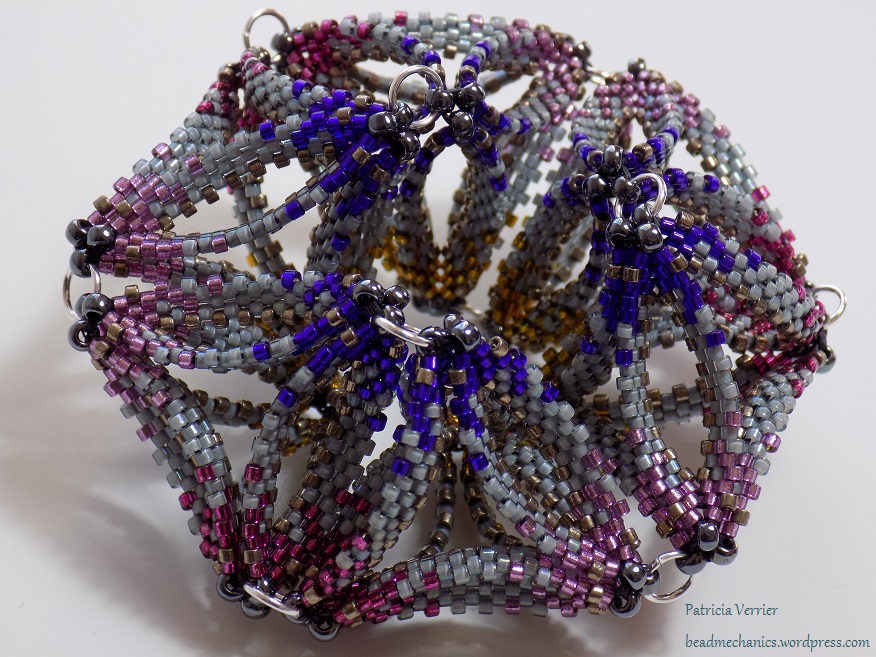
As you may have guessed from the kaleidocycle, I like making geometric shapes out of beads! The first shape I tried was a dodecahedron (or an icosahedron, depending on how you look at it). Here’s a photo of the finished piece.

DSCN0101

I made this a few years ago but it’s still one of my favourites. The shape is made up of a lot of individual peyote ovals (like a triangle but with only two points, I learnt about them from Diane Fitzgerald’s book Shaped Beadwork).

If you think of it as a dodecahedron then five of the ovals (or rather, five half-ovals) make up each hexgonal face, while if you think of it as an icosahedron then each oval corresponds to an edge.

Each oval is one of five colours, but they occur in a different order in each hexagonal face. After a bit of reading I found out that this is because the symmetries of a dodecahedron (or icosahedron, they’re essentially the same) are the same as a particular permutation group. (Or in full maths detail: its symmetry group is isomorphic to the alternating group A5, which is the group of all even permutations of a set of 5 elements.) So not only does it look cool it has some pretty neat maths behind it as well!